Female hair thinning affects more than 50% of women at some point in their lives[29], yet many dismiss the early warning signs until the problem becomes severe. You can address the issue earlier if you know how to tell if your hair is thinning. Recognizing the first signs of hair loss requires knowing what’s normal versus what signals a concern.
Understanding Normal Hair Loss vs. Hair Thinning
What’s Normal Daily Hair Shedding?
Before you panic about the strands piling up in your shower drain, you need to know what’s actually normal. Your scalp sheds between 50 and 100 hairs each day as part of the natural hair cycle[1]. Some sources indicate this range can extend up to 150 hairs per day[2]. This might sound alarming, but your head hosts around 100,000 hair follicles[1]. Losing 100 strands barely makes a dent in your overall hair density.
This daily shedding happens because not all of your hair follicles operate on the same schedule. Each follicle works on its own, which prevents you from losing all your hair at once[31].
When Does Hair Loss Become a Concern?
Hair shedding is different from hair loss. Your follicles remain healthy and capable of producing new growth when hair sheds[32]. Hair loss involves follicles that stop producing new strands or shrink over time[33]. Normal shedding feels sudden and temporary. Hair loss appears more gradual and patterned[33].
The pull test offers a simple way to assess your situation. Gently grasp a small section of clean, dry hair that contains about 50 to 60 strands. Run your fingers through with mild tension, not tugging hard. You might be experiencing excessive shedding if more than 10 hairs come loose in your hand[1].
Physical Signs of Hair Thinning You Can See
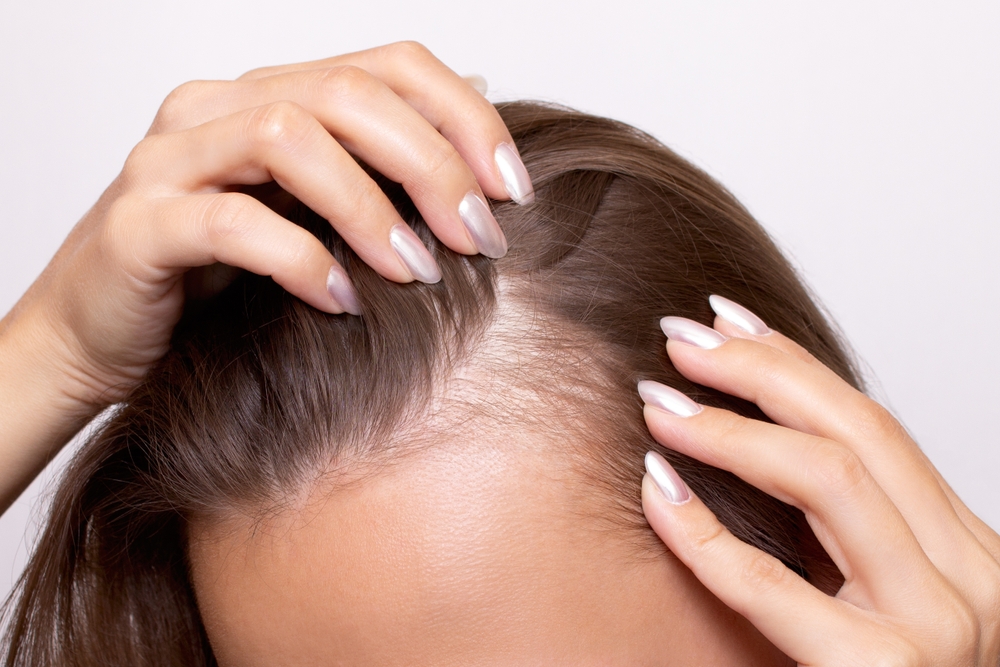
Wider Part Line on Your Scalp
Your part line serves as a reliable indicator of hair density changes. A wider part signals that you’ve lost close to 50% of your hair in that area[35]. You might notice a “Christmas tree” pattern where your part fans backward and appears wider at the back than at the front[36].
Thinner Ponytail or Braid
Your usual hair tie tells its own story about hair density. Wrap your ponytail holder around your gathered hair and count how many times it circles. You’re experiencing measurable thinning if you can loop it one or two extra times compared to a year ago[36].
More Visible Scalp
Seeing your scalp through your hair doesn’t mean you’re balding[37]. Fine or light-colored hair shows more scalp, and certain hairstyles or part placements can increase visibility without hair loss [37]. But if scalp visibility has increased compared to previous years, your hair density may be dropping[36]. This is especially true when you look straight down at your crown in bright lighting[36].
Changes in Hairline
Women experience a broadening of the part rather than a receding hairline[38]. That said, frontal fibrosing alopecia creates a common pattern of hairline recession in older women[38]. You might notice your forehead looks larger than usual or see thinning around your temples.
Check for temple area thinning or an “M” shape that forms at your hairline[39]. Watch for broken hairs around your forehead or patches of hair loss where tension occurs if you wear tight hairstyles[40].
Increased Hair on Pillow or in Shower Drain
Hair on your pillow or strands that circle your shower drain becomes concerning when the amount exceeds your normal baseline. You might be experiencing hair loss if you see 150 to 200 hairs daily in the shower, on your pillow, or while styling[36].
Textural Changes That Signal Hair Thinning
How your hair feels and behaves during styling reveals critical information about hair thinning in women, beyond what you can see in the mirror. Textural changes often appear before visible thinning becomes obvious and make them valuable early signs of hair loss.
Finer Hair Strands
Hair that feels noticeably thinner or finer than before signals follicular miniaturization, one of the most overlooked warning signs of progressive hair loss[5].
You might notice your hair doesn’t hold styles as well as it used to. It may reach a shorter maximum length even when you try growing it out[5]. The loss of natural shine and luster accompanies this texture move[5]. These changes occur because your follicles are producing hair with reduced diameter and strength[5].
Reduced Hair Density
Hair thinning represents a prolonged decrease in the overall volume and density of your hair[10]. This gradual process is different from sudden shedding because it involves hair becoming thinner and more brittle, which causes it to fall out more quickly[10].
You’ll notice this reduction especially in the frontal and crown regions of your scalp, where hair tends to be most susceptible to hormonal effects[42]. Wispy hair or thinner strands replace thicker hair in areas affected by hair loss[42]. Fine hair shows some scalp, but increased visibility over time indicates dropping density levels.
Hair Breaking More Easily
Thin hair breaks about 10 times more than thick hair[11]. Fine hair contains approximately 50% less protein than thick hair, and this makes it more vulnerable[11].
Watch for these telltale signs that your hair is suffering from breakage:
- Dullness and loss of shine
- Excessive frizz throughout the length
- Split ends appearing sooner than usual
- Unmanageability during styling[11]
Breakage is different from hair thinning signs because it occurs along the hair shaft below the scalp surface rather than at the root[10]. Tight hairstyles like buns, cornrows, or braids can stretch or break hair away from the root and potentially lead to traction alopecia if the damage continues[13].
Common Patterns of Female Hair Thinning
Thinning at the Crown and Top of Head
Crown thinning represents one of the most common patterns in female hair thinning[6]. You’ll notice gradual density loss at the top and back of your scalp, especially along the part line[6]. This pattern is different from male baldness because women maintain their frontal hairline while experiencing thinning behind it[14].
Overall Diffuse Thinning
Diffuse thinning spreads in your entire scalp rather than concentrating in one area[16]. This pattern involves thinning over the mid-frontal scalp with a widening of the midline part[16]. The Ludwig Classification describes three stages: Type I shows minimal thinning you can camouflage with styling, Type II presents decreased volume with noticeable part widening, and Type III displays diffuse thinning with a see-through appearance on top[14].
Patchy Hair Loss Areas
Patchy hair loss indicates alopecia areata, an autoimmune condition affecting nearly 7 million people in the United States[17]. You’ll see sudden loss of round or oval patches, about the size of a quarter[17]. Short broken hairs or “exclamation point” hairs that narrow at their base may appear around patch edges[18]. The bare areas show no rash, redness, or scarring[18].
Receding Hairline in Women
Women rarely develop a receding hairline, unlike men[14]. When it occurs, frontal fibrosing alopecia may be responsible[19]. Bitemporal recession can develop independently of mid-frontal thinning, starting after puberty and progressing mildly[15]. Some women experience an “M” shape like male recession, though this remains uncommon[19].
What Your Hair Thinning Signs Might Indicate
A number of factors can lead to hair thinning:
- Hormonal imbalances and changes, including postpartum hormonal changes, especially estrogen decreases[7], menopause[20], and hypothyroidism[7].
- Nutritional deficiencies, including iron deficiency[8], low vitamin D[8], vitamin B12 deficiency[8], and zinc deficiency[8].
- Stress-related hair loss, including physical or emotional stress[22], as well as major surgery, severe illness, trauma, or substantial weight[23].
- Genetic factors and family history.
- Medical conditions, including systemic lupus, thyroid disorders, diabetes, and autoimmune conditions[26].
- Medication, including beta-blockers, retinoids, anticoagulants, and birth control pills[7][9].
Early recognition gives you the best chance to address thinning before it progresses. Schedule a consultation with a practitioner at Beauty Vault in West Hollywood to review your specific situation and develop an individual-specific treatment approach that targets your mechanisms. Call us today at (323) 800-6770 or fill out our contact form to schedule an appointment.
FAQs
Q1. What nutritional deficiencies can cause hair loss in women?
Several vitamin and mineral deficiencies can trigger hair thinning. Iron deficiency is one of the most common causes, as your body prioritizes blood production over hair growth. Low levels of vitamin D can disrupt the hair follicle cycling process, while vitamin B12 deficiency reduces oxygen delivery to follicles. Zinc deficiency leads to increased shedding and slower regrowth. Additionally, crash dieting and insufficient protein intake can trigger a condition called telogen effluvium, where hair prematurely enters the shedding phase.
Q2. Can female hair thinning be reversed or treated?
Yes, many cases of female hair thinning can be addressed, especially when caught early. The success of treatment depends on identifying and addressing the underlying cause. Hormonal imbalances, nutritional deficiencies, stress-related hair loss, and certain medical conditions can often be managed with appropriate interventions. Early recognition provides the best opportunity to prevent further progression. A personalized treatment approach that targets your specific triggers offers the most effective results.
Q3. What is the most common cause of hair loss in women?
Female pattern baldness, also known as androgenetic alopecia, is the most common cause of hair loss in women, affecting approximately 30 million American women. This condition is influenced by genetic factors and hormonal changes, particularly the effects of DHT (dihydrotestosterone) on hair follicles. Women with early-onset female pattern hair loss show a 71.4% positive family history rate, with maternal history being particularly significant.
Q4. How can I tell if my hair loss is normal or a cause for concern?
Normal hair shedding involves losing 50 to 150 hairs daily as part of the natural growth cycle. Hair loss becomes concerning when you consistently see more than 150 hairs daily, notice a widening part line, experience thinner ponytails, or observe increased scalp visibility. A simple pull test can help assess your situation: Gently grasp about 50-60 strands of clean, dry hair and run your fingers through with mild tension. If more than 10 hairs come loose, you may be experiencing excessive shedding that warrants professional evaluation.
Q5. Are there medical conditions that can cause hair thinning?
Yes, several medical conditions can manifest as hair loss. Thyroid disorders, particularly hypothyroidism, can slow hair growth cycles and cause chronic shedding. Autoimmune conditions like alopecia areata cause patchy hair loss, while systemic lupus, diabetes, and PCOS (polycystic ovary syndrome) can also trigger hair thinning. Additionally, certain medications, including beta-blockers, retinoids, anticoagulants, and some birth control pills, can cause drug-induced hair loss, typically appearing two to four months after starting the medication.
References
[2] – https://time.com/6997830/how-much-hair-loss-is-normal-women-aging/
[3] – https://www.healthline.com/health/stages-of-hair-growth
[4] – https://dermnetnz.org/topics/female-pattern-hair-loss
[5] – https://atlantahairsurgeon.com/5-warning-signs-your-hair-loss-is-progressing/
[6] – https://www.nioxin.com/en-GB/blog/about-hair-loss/causes-treatments-women-with-crown-hair-thinning
[7] – https://www.ncbi.nlm.nih.gov/books/NBK430848/
[8] – https://www.bosley.com/blog/which-vitamin-deficiency-causes-hair-loss/
[9] – https://www.webmd.com/skin-problems-and-treatments/hair-loss/drug-induced-hair-loss-2
[10] – https://www.realsimple.com/hair-thinning-vs-hair-loss-vs-hair-breakage-6824277
[11] – https://www.nexxus.com/us/en/haircare-101/what-causes-hair-breakage.html
[12] – https://www.healthline.com/health/hair-breakage
[13] – https://www.medicalnewstoday.com/articles/325026
[14] – https://www.health.harvard.edu/healthy-aging-and-longevity/treating-female-pattern-hair-loss
[15] – https://pmc.ncbi.nlm.nih.gov/articles/PMC2684510/
[16] – https://dermnetnz.org/topics/diffuse-alopecia
[17] – https://my.clevelandclinic.org/health/diseases/12423-alopecia-areata
[18] – https://www.niams.nih.gov/health-topics/alopecia-areata
[19] – https://www.themaitlandclinic.com/receding-hairline-in-women/
[20] – https://pmc.ncbi.nlm.nih.gov/articles/PMC9788837/
[21] – https://medlineplus.gov/genetics/condition/androgenetic-alopecia/
[22] – https://www.medicalnewstoday.com/articles/321590
[23] – https://my.clevelandclinic.org/health/diseases/24486-telogen-effluvium
[24] – https://michderm.com/blog/hormonal-imbalance-and-hairloss
[25] – https://pmc.ncbi.nlm.nih.gov/articles/PMC10379895/
[26] – https://www.health.harvard.edu/a_to_z/hair-loss-a-to-z
[28] – https://www.aad.org/news/hair-loss-in-women-tied-diseases
[29] – https://my.clevelandclinic.org/health/diseases/16921-hair-loss-in-women
[30] – https://www.webmd.com/skin-problems-and-treatments/hair-loss/women-hair-loss-causes
[31] – https://www.philipkingsley.com/hair-guide/hair-science/hair-growth-cycle.html
[32] – https://bosleymd.com/blogs/hair-thinning/hair-shedding-vs-hair-loss-key-differences
[33] – https://www.nbcnews.com/select/shopping/hair-shedding-vs-hair-loss-explained-rcna260303
[34] – https://www.healthline.com/health/how-much-hair-loss-is-normal
[35] – https://www.marthastewart.com/8086083/wider-part-line-hair-loss-tips
[38] – https://www.mayoclinic.org/diseases-conditions/hair-loss/symptoms-causes/syc-20372926
[40] – https://www.aad.org/public/diseases/hair-loss/causes/hairstyles
[41] – https://www.monadermatology.com/hair-loss-in-the-shower/
[42] – https://restorehair.com/recognizing-the-first-signs-of-hair-thinning/
[43] –https://www.health.com/why-hair-texture-changes-with-age-11986846