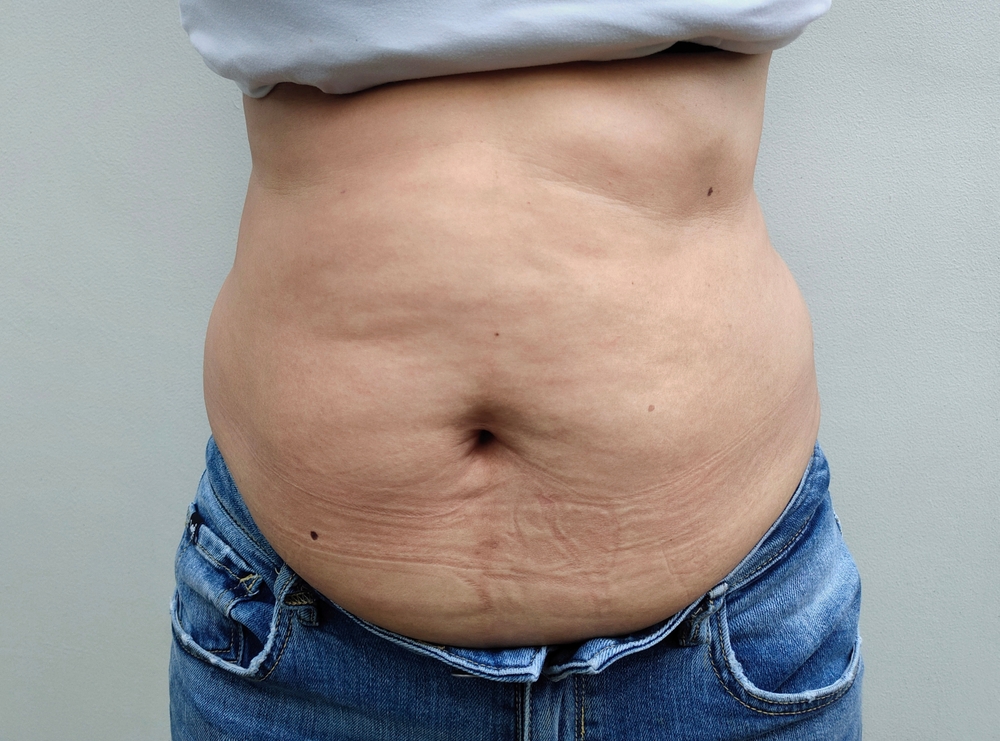
Loose skin after pregnancy is a natural occurrence that many women experience, and sagging skin can be challenging to treat at home. Luckily, non-invasive skin tightening treatment options can help new mothers address post-baby body changes without surgery. This piece explores what causes post-pregnancy loose skin and professional non-surgical skin tightening procedures you might consider.
What Causes Sagging Skin After Having a Baby
As skin ages, it loses elastin and collagen. Carrying extra weight during pregnancy can further affect these proteins.
Your abdomen expands to accommodate your growing baby as you go through pregnancy, and your skin stretches over nine months. This stretching affects the dermis, the deeper layer of skin, which can exceed its natural elasticity [1]. For this reason, the elastic fibers may not snap back completely when tissue remains stretched for this prolonged period [2].
Your skin relies on collagen and elastin proteins that work together to allow stretching and retraction. Research shows that skin becomes less elastic and less deformable on the abdomen as pregnancy progresses, with loss of elasticity and firmness also observed on the thighs [3]. Often, skin does not return to its original state even four months after delivery [3].
Your skin attempts to repair the disrupted elastic network, but this process does not appear to work, which leads to a lax, loose skin appearance [4]. In other words, the elastic fiber network in the dermis gets disrupted, and this network remains disrupted after giving birth [4].
The Role of Rapid Weight Gain During Pregnancy
Weight gain affects loose skin postpartum [5]. The recommended weight gain varies based on your pre-pregnancy BMI, but whatever the amount, rapid or excessive gains can stretch your skin beyond its capacity to bounce back [1]. Even postpartum weight loss can make sagging skin more obvious if it occurs quickly because volume drops faster than your skin tightens [2].
How Age Affects Skin Recovery Postpartum
Your age is also a major factor in skin elasticity. Younger skin contains more collagen and elastin, which makes it more resilient and better able to bounce back after stretching [1]. Women who become pregnant in their early twenties often experience better natural skin retraction compared to those who have children later in life [1]. In contrast, older women often experience less skin elasticity and find postpartum tightening more challenging [1].
Additionally, each pregnancy can have a cumulative effect on your skin’s elasticity. The skin stretches further with each one, and its capacity to retract may diminish [1]. This is especially true if pregnancies occur close together and give your skin little time to recover between stretching periods [1].
Twin and Multiple Pregnancy Impact on Skin
Similarly, carrying twins or multiples increases the stretch load on your skin [2]. The increasing bulk of the uterus causes the skin to stretch to a great extent and tears the elastin fibers [6], usually resulting in more pronounced stretching that affects your skin’s capacity to return to its pre-pregnancy state [1].
Genetic Factors in Post-Baby Skin Elasticity
Your genetic makeup influences how your skin responds to stretching and its capacity to retract [1]. Some women naturally have more elastic skin that bounces back more readily after pregnancy, while others may have less elastic skin that’s more prone to laxity [1].
Professional Non-Surgical Skin Tightening Procedures
Several non-surgical skin tightening procedures use targeted energy to heat deeper skin layers and stimulate collagen and elastin production. These technologies can address mild to moderately loose skin on your body without incisions or scars [7]. The treatments work gradually over weeks or months following your session [7].
Thermage: Single-Session Radiofrequency Treatment
Thermage uses monopolar radiofrequency energy to deliver heat deep into your dermal tissues. This causes existing collagen fibers to contract immediately while triggering new collagen production [7]. Thermage delivers results after a single treatment, unlike many non-surgical skin-tightening treatments, which require multiple sessions [1]. Still, most patients see measurable results gradually appear in the two to six months following treatment [1][1].
Microfocused Ultrasound for Deep Tissue Tightening
Microfocused ultrasound technology uses focused ultrasound energy to heat your skin at specific depths up to 5mm deep. This reaches the same foundational layer addressed in surgical facelifts [6]
[7]. Ultherapy, the most prominent system, is the only FDA-cleared procedure to lift skin on the neck, chin, and brow [9].
The technology transmits ultrasound waves through your skin’s surface via a handheld device [7]. These waves create small thermal coagulation points where temperatures reach greater than 60°C briefly. This causes collagen fibers to denature and contract [6].
Laser Therapy Options for Collagen Stimulation
Laser treatments create controlled micro-injuries in your dermis and trigger your body’s natural healing response [12]. More specifically, fractional CO2 lasers and non-ablative resurfacing use light energy to create micro-channels of heat that tighten skin while improving texture [9].
Low-level laser therapy stimulates collagen production by activating mitochondrial chromophores in your skin cells [13]. This activation boosts cellular metabolism and triggers signaling pathways that promote tissue repair [13]. The collagen stimulation process occurs in distinct phases, with newly formed collagen integrating into your skin over several weeks to months [12].
Treatment Planning
Understanding what non-surgical skin tightening treatments can accomplish helps you make informed decisions about your postpartum recovery trip.
When to Start Non-Surgical Treatments After Delivery
Beauty Vault practitioners recommend waiting at least three to six months after childbirth before considering non-invasive skin tightening treatment [8]. This waiting period allows your body to recover and your weight to stabilize. If you’re breastfeeding, you’ll need to wait an additional six months or longer after weaning your baby [8].
For many mothers, postpartum recovery takes much longer than they expect. Realistic timeframes extend from 6 to 18 months rather than the assumed six weeks [17]. Hormone levels don’t return to pre-pregnancy levels until you stop lactating, which for many women means one to two years [17].
Combining Multiple Procedures for Better Results
Different treatment methods used together produce superior results that last longer than single procedures [18]. Combination therapy addresses multiple layers at once because fat, muscle and skin each require different approaches [6].
Understanding the Limitations
Non-surgical skin tightening procedures are not intended to treat obesity or contribute tot health benefits associated with weight loss, so they will likely work best with mild to moderate skin laxity [20]
[18]. Deep wrinkles, major sagging, or significant changes might be beyond their rectifying capabilities [21]. Of course, outcomes vary based on factors like age and skin type [21].
Timeline: 4-6 Months for Full Treatment Effects
Real collagen effects begin to show after four to six weeks [23]. Most patients notice moderate tightening and lifting within 2 to 6 months after a single treatment [24]. Peak results appear around the three- to six-month mark as collagen remodeling completes [25]. Treatments require three to six sessions spaced about four to six weeks apart [26].
Long-Term Maintenance Requirements
Maintenance treatments every three to six months help preserve your results [11]. You should remain within 20 pounds of your goal weight. Weight fluctuations can compromise outcomes [29]. Future pregnancies may undo non-surgical skin tightening results [29].
Let the Beauty Vault Help You Return to Your Pre-Pregnancy Body
Your body goes through many difficulties to have a baby, so you deserve options for addressing post-pregnancy skin laxity to help you feel like yourself again. Non-surgical treatments like radiofrequency and laser therapies might be just the answer you need. Come to the Beauty Vault in West Hollywood to learn more about whether it’s right for you. Call us today at (323) 800-6770 or fill out a contact form to make an appointment.
FAQs
Q1. Is it possible to tighten loose skin after pregnancy without having surgery? Yes, non-surgical options can help address mild to moderate skin laxity after pregnancy. Treatments like radiofrequency (Thermage), microfocused ultrasound (Ultherapy), and laser therapies work by stimulating your body’s natural collagen production. These procedures typically show results over four to six months and work best when combined with exercise and proper nutrition. However, they are most effective for mild to moderate cases, while severe skin laxity may require surgical intervention.
Q2. How can I reduce loose skin and the “mom pooch” after having a baby? For mild to moderate cases, non-surgical treatments like radiofrequency and ultrasound can help tighten skin by stimulating collagen production. Combining these with resistance training and Pilates to strengthen abdominal muscles, maintaining proper hydration, and eating a vitamin-rich diet can support improvement. For more significant loose skin and muscle separation, a tummy tuck (abdominoplasty) may be necessary to remove excess skin and tighten abdominal muscles.
Q3. When should you start considering skin tightening treatments after giving birth? Beauty Vault practitioners recommend waiting at least three to six months after delivery before starting non-surgical skin tightening treatments. This allows your body to recover naturally and your weight to stabilize. If you’re breastfeeding, you should wait an additional 6 months or longer after weaning, as hormone levels don’t return to pre-pregnancy levels until lactation stops.
Q4. How long does it take to see results from non-surgical skin tightening treatments? Non-surgical skin tightening treatments work gradually as your body produces new collagen. You’ll typically begin noticing improvements after four to six weeks, with moderate tightening and lifting visible within two to six months. Peak results usually appear around the three- to six-month mark as the collagen remodeling process completes. Most treatments require three to six sessions spaced about four to six weeks apart for optimal results.
Q5. What are the limitations of non-surgical skin tightening methods after pregnancy? Non-surgical treatments work best for mild to moderate skin laxity but cannot address severe sagging or multiple folds of excess skin. They are not designed for weight loss or obesity treatment, and results vary based on skin type, age, and individual response. Significant skin laxity, extensive stretch marks, or severe muscle separation typically require surgical intervention like abdominoplasty for meaningful improvement.
References
[2] – https://momcozy.com/blogs/momcare/excess-skin-after-pregnancy-what-helps
[3] – https://pubmed.ncbi.nlm.nih.gov/29479745/
[4] – https://record.umich.edu/articles/what-happens-your-skin-when-pregnancy-gives-you-stretch-mark/
[5] – https://www.monadermatology.com/firming-body-creams/
[6] – https://www.medicalsparx.com/non-surgical-body-contouring-procedures/
[7] – https://www.americanboardcosmeticsurgery.org/cosmetic-procedures/non-surgical/skin-tightening/
[9] – https://plasticsurgerygroupnewjersey.com/non-surgical-skin-tightening/
[10] – https://pmc.ncbi.nlm.nih.gov/articles/PMC4149887/
[11] – https://belislaser.com/faqs/how-often-should-i-do-rf-skin-tightening
[12] – https://dermatologyseattle.com/how-lasers-target-skin-layers-and-stimulate-collagen-production/
[13] – https://pmc.ncbi.nlm.nih.gov/articles/PMC4126803/
[14] – https://inspireatlanta.com/can-pilates-help-with-diastasis-recti/
[16] – https://www.paulaschoice-eu.com/the-truth-about-firming-creams
[18] – https://coronaclinic.com/combination-therapy-for-skin-tightening/
[19] – https://pmc.ncbi.nlm.nih.gov/articles/PMC7515474/
[20] – https://southernaesthetic.com.au/the-postpartum-body-and-body-contouring-when-is-the-right-time/
[23] – https://greenspringaesthetics.com/collagen-stimulation-timeline-30-60-90-days/
[24] – https://evolutionmadison.com/a-realistic-timeline-for-skin-tightening-treatments/
[25] – https://allenmedicalaesthetics.com/blog/ultherapy-before-and-after
[26] – https://www.spamedica.com/blog/how-to-tighten-skin-after-pregnancy-without-surgery/
[28] – https://axiomaesthetics.co.uk/understanding-skin-laxity-when-to-choose-which-treatment/
[29] – https://www.plasticsurgery.org/news/blog/getting-the-best-results-from-nonsurgical-body-contouring
[30] – https://nubodyconcepts.com/body/tummy-tuck/tummy-tuck-vs-skin-tightening/
[32] – https://www.plasticsurgery.org/documents/health-policy/guidelines/guideline-2017-skin-redundancy.pdf